

DEAF LIFE & SIGN LANGUAGE
Being Deaf is a part of who I am and has shaped the way I experience the world. Sign language is more than communication to me — it connects me with people, experiences and the Deaf community. Over the years, I have taken part in different events and moments that became part of my story. Here, I share those experiences, from my younger years to where I am today.
MY FIRST MEDIA INTERVIEW
In 2012, when I was still young, my class travelled to Warsaw as part of a school trip. Through our school, we were given a special opportunity connected with Rodzinka.pl and TVP2. The visit had been organised for us by people I did not personally know. At first, I thought it would simply be another part of our school trip. I had no idea that I would suddenly become personally involved in something completely new.
Once we were there, things began to happen unexpectedly. My teacher chose me to take part. As I remember it, one of the reasons was that she believed I had a good and clear speaking voice. I was surprised. I had not arrived in Warsaw expecting to speak in front of television cameras, and one of the thoughts going through my head was simply: “Why me?”
Everything had to be prepared there, on the spot. I was given material on paper and had only a short amount of time to learn it, repeat the sentences and practise what I needed to say. I took it seriously. I tried to concentrate, remember everything and prepare myself mentally before it was time to stand in front of the camera.
This was especially significant to me because I was a young Deaf person at the time. My experience of communication, learning and confidence was very different from the way I experience those things today. Having to absorb information quickly, practise it and then speak publicly in a completely unfamiliar situation was a serious challenge for me.
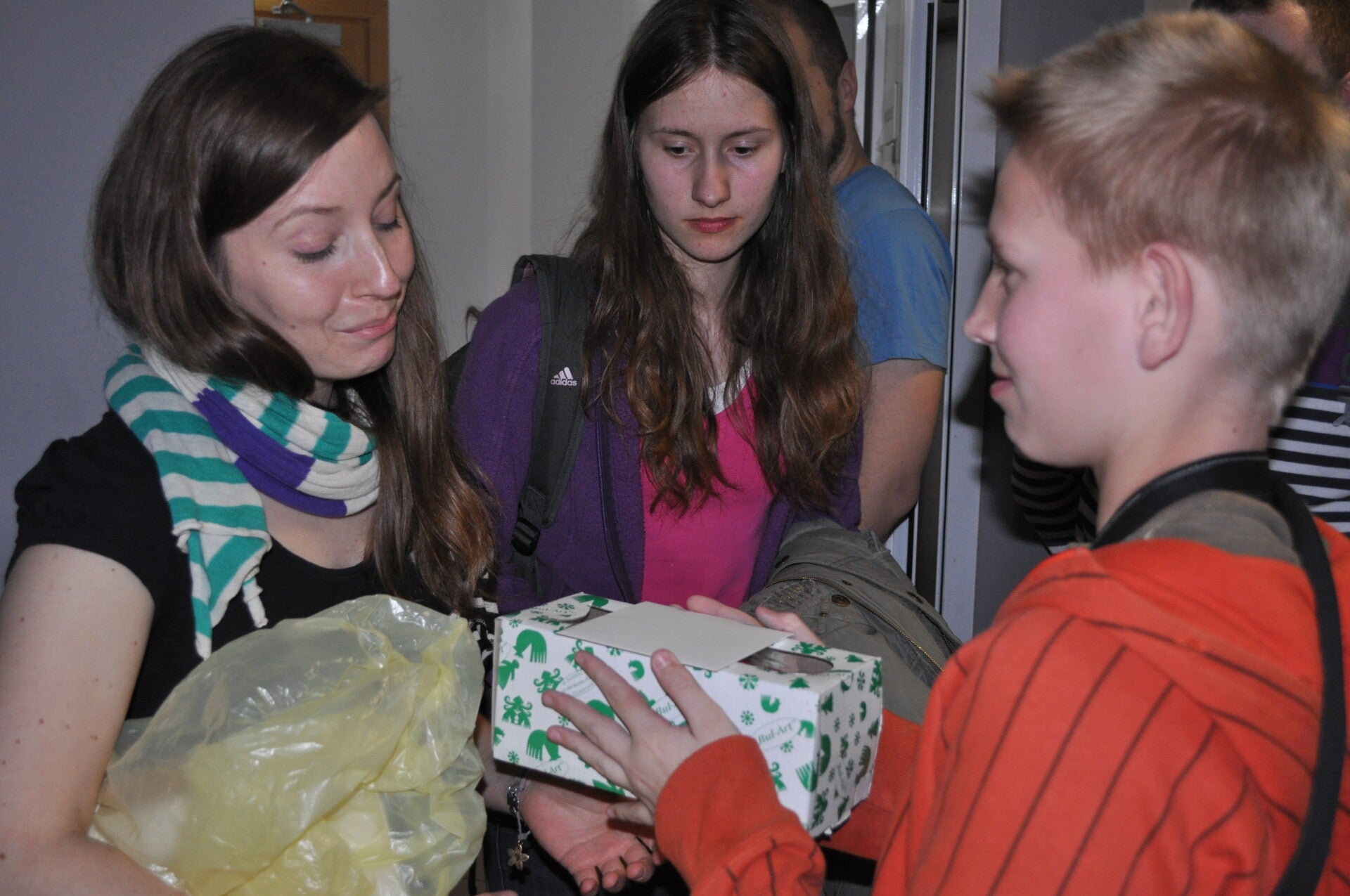
It was not only one moment. As I remember it, I had to go through this kind of preparation three separate times, because three different situations came one after another. The first involved personally giving a gift I had prepared to one of the women at the event. Later came a moment with Małgorzata, and then another with Tomasz. Each time, it happened quite suddenly: I was given material on paper, had a short amount of time to learn and practise what I needed to say, and then had to be ready to do it in front of the cameras.
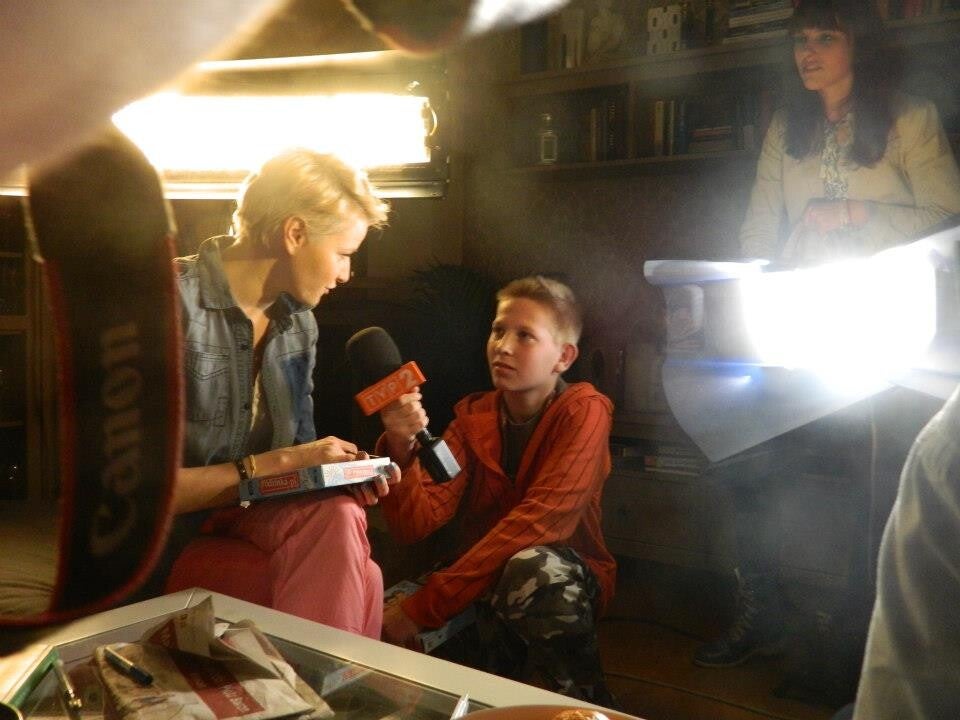
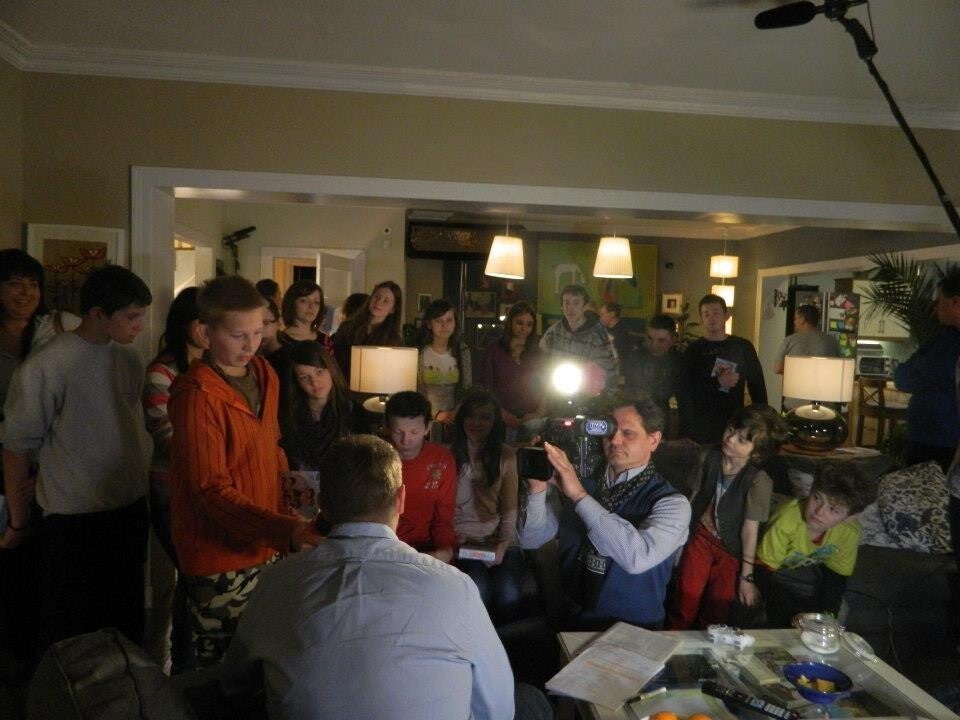
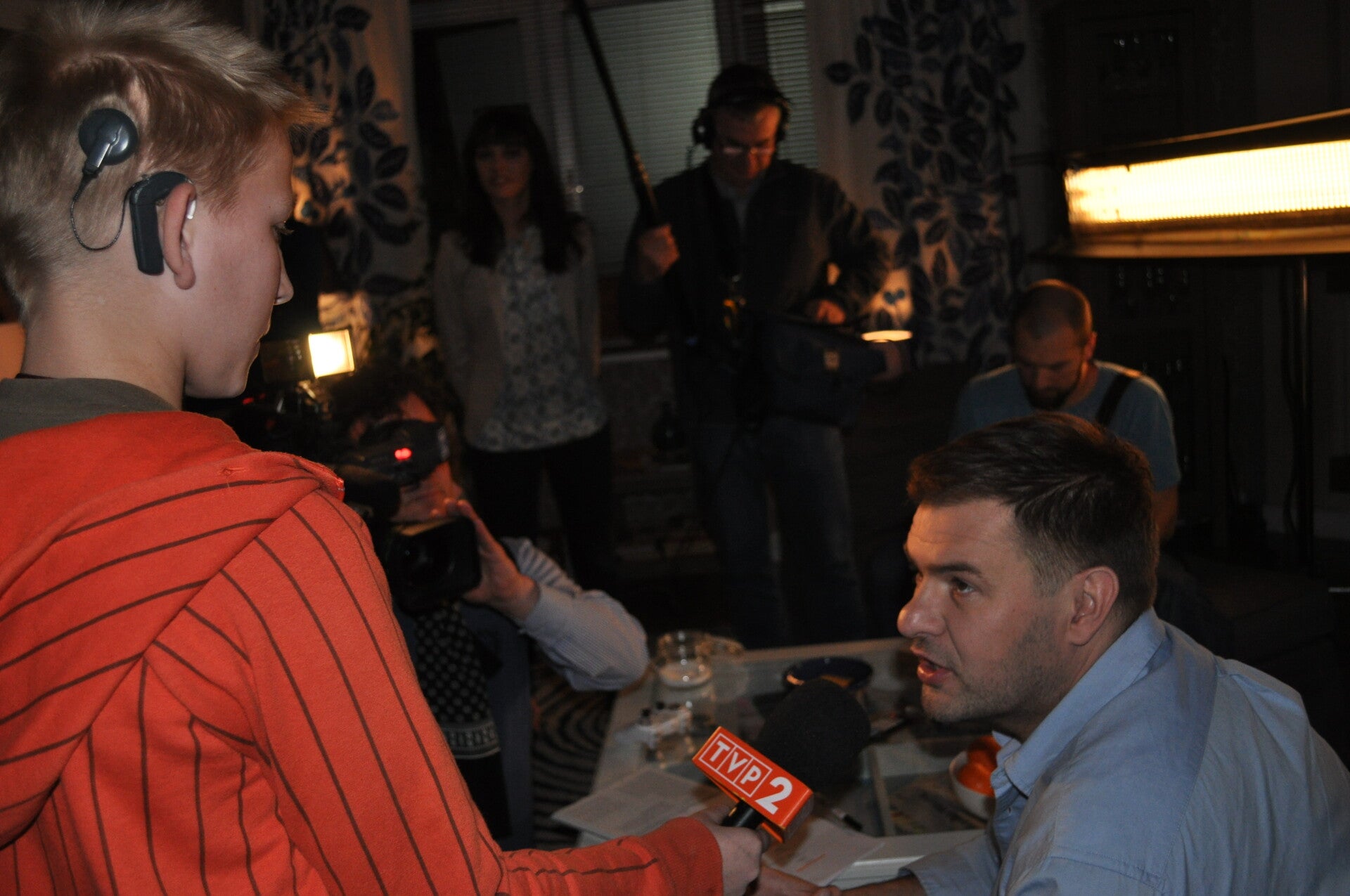
Then came the moments in front of the TVP2 camera, lights and microphone. What had started as a school trip suddenly became a real media experience. I knew that what I was doing could later be shown publicly to viewers across Poland. For someone my age, experiencing something like this for the first time, it was difficult to fully understand in the moment how unusual the situation really was.
I was nervous and shy. Inside, I did not always feel ready. But I tried to control those feelings and turn them into something positive. I wanted to stay mentally strong, remember what I had practised and do the best I could. Instead of allowing the fear to stop me, I went ahead and did it.
At the time, part of me felt almost as if I had suddenly become known because I had appeared in a real television environment. But looking back, I would not describe myself as famous. That was never the real meaning of this experience. What mattered was that I had been given an unexpected opportunity and managed to face something completely new.
Afterwards, people around me appreciated what I had done. Teachers, the school director and others congratulated me. I remember feeling proud and happy, even though I was also embarrassed by all the attention. For me, it felt like an important step and one of my first experiences of achieving something that I had never expected myself to do.
I am grateful to the people who organised this opportunity for our school and class, even though I did not personally know everyone behind it. I am also grateful to my teacher for choosing me and helping me prepare when everything happened so suddenly. Without those people, this experience probably would never have become part of my life.
Accessibility is also part of how I remember this experience. As a Deaf person, older television material can be difficult to follow or find in an accessible form, especially when subtitles are missing. Unfortunately, I no longer know where the original video material from those moments is. I hope that one day I may be able to find it again.
What I still have are the original photographs from that experience. When I look at them today, I remember being young, suddenly being chosen, receiving the material on paper, having very little time to practise, asking myself “Why me?”, and then finding enough courage to go in front of the camera.
Today, I see that experience differently than I did as a teenager. At the time, it was unexpected, stressful, exciting and sometimes embarrassing. Years later, it has become a happy and important memory. I am glad that I accepted the opportunity and tried, because it showed me at a young age that sometimes an unexpected moment can become part of your story for the rest of your life.
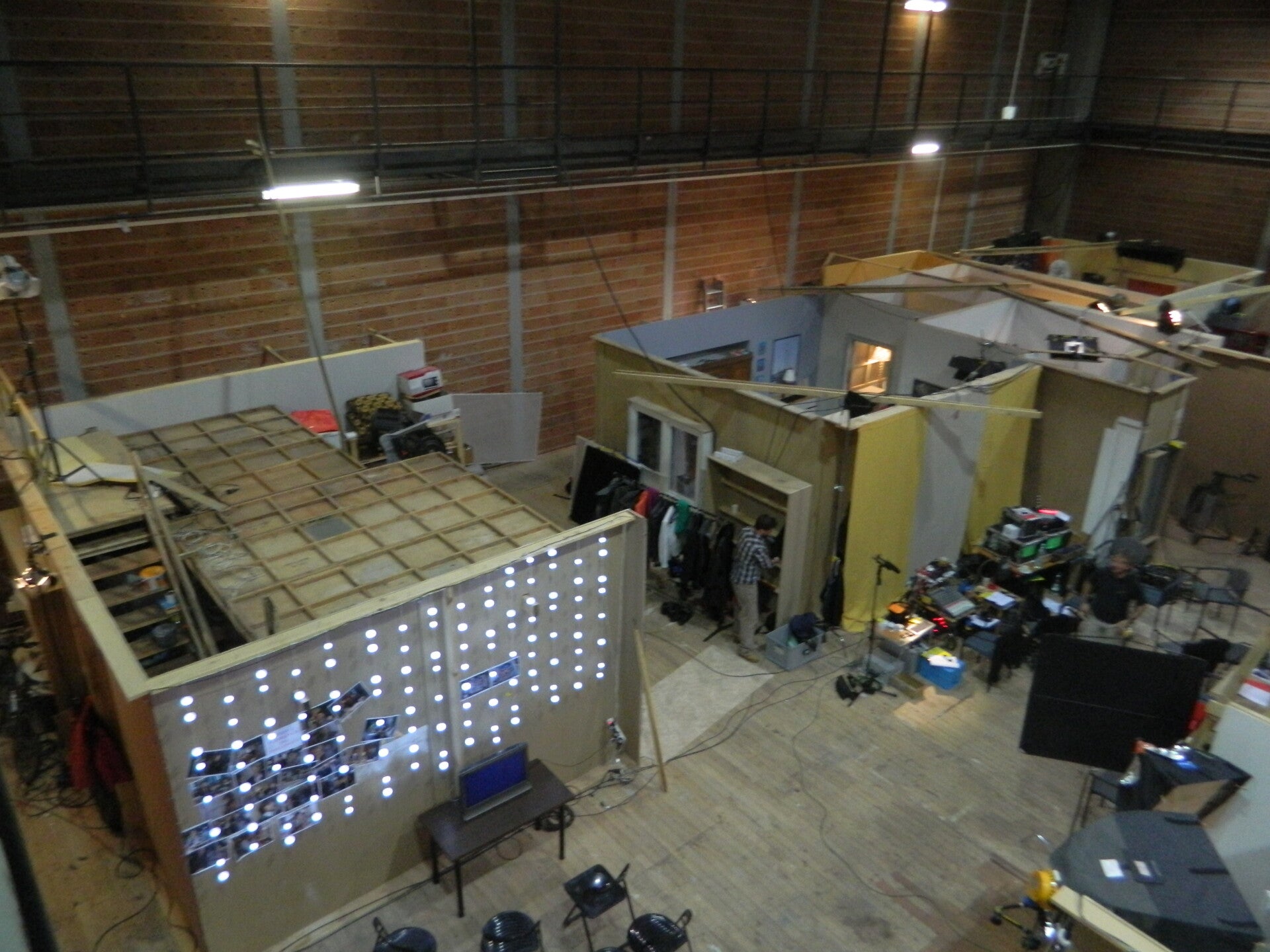
Sometimes one unexpected moment can become part of your story for the rest of your life.
CRACOVIA & SIGN LANGUAGE
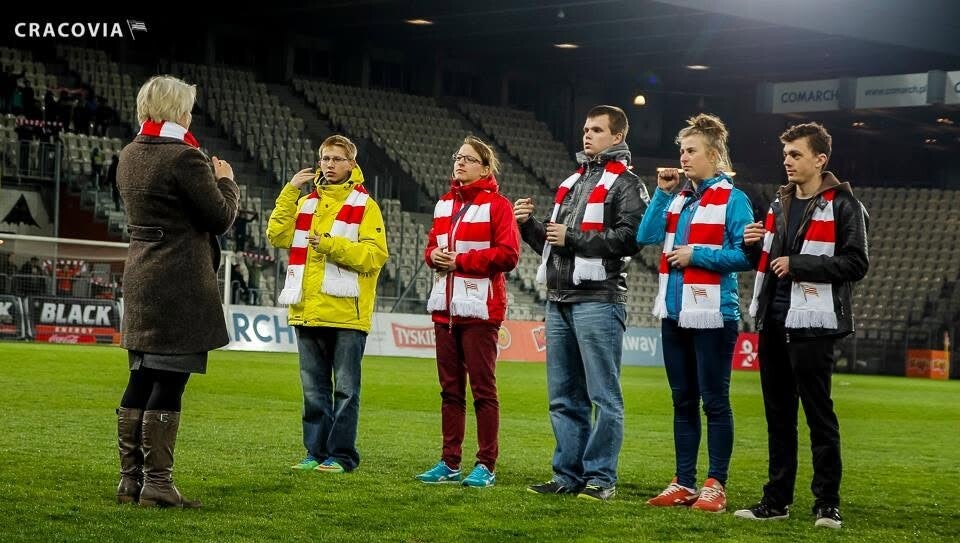
On 18 April 2015, I had the opportunity to take part in a special event at Cracovia Stadium in Kraków. Together with four other young Deaf people from our Special Educational Centre for Deaf Students in Kraków, we formed a group of five who performed Cracovia’s anthem in sign language before the match against Pogoń Szczecin.
Our teacher was also there with us. She also worked with us at the boarding school, knew us well, looked after us and supervised our group during the event. Altogether, there were six of us.
We had prepared for this day beforehand at school. As I remember it, for around two weeks we learned and practised the anthem in sign language. We repeated the signs many times, remembered their order and prepared ourselves to perform it together at the stadium.
In some ways, it reminded me of my earlier television experience in Warsaw in 2012, although the task was completely different. In Warsaw, I was given material on paper and had only a short amount of time to learn what I was going to say in front of the camera. With Cracovia, there was no script to learn from a piece of paper. This time, our task was sign language.
After around two weeks of preparation, the actual day finally arrived.
One of my strongest memories is walking towards the pitch. I remember going through the doors and suddenly seeing the bright, open space of the stadium in front of me. It felt completely different from simply looking at a football pitch from the stands.
When I stepped onto the grass and saw the entire pitch from that level, it made a huge impression on me.
The pitch looked much bigger than I had imagined.
When I was younger, I had played football, including in Krzeszowice. I already knew what it felt like to be on a normal football pitch, but stepping onto the grass of a professional stadium was completely different. For a brief moment, I could imagine what it might feel like for a professional footballer to walk out onto a large stadium.
Of course, I was not there as a player. I was there together with our group to perform Cracovia’s anthem in sign language.
I also remember wearing my Cracovia scarf.
Our purpose on the pitch was simple and clear. We walked onto the grass, performed the anthem in sign language and, when our part was finished, we left the pitch.
Before the first whistle, the five of us stood on the pitch and prepared to do what we had been practising for the previous two weeks.
Then the anthem began.
While the anthem was being played and people around the stadium were singing, the five of us performed it together in sign language.
I am Deaf, but at that time I used a cochlear implant, which allowed me to hear the sounds around me. At the stadium, I remember the voices and shouting of the crowd, the singing, and different beats and rhythms that, in my memory, felt something like “knock, knock”. All of those sounds mixed together with the atmosphere inside the stadium.
At the same time, we were performing the anthem visually through sign language. People around the stadium were singing and creating the atmosphere with their voices, while our group performed the signs we had practised beforehand.
It was an interesting combination for me. I was experiencing the sounds of the stadium through my implant while at the same time using my hands to perform the anthem together with the other four young Deaf people.
Our performance itself did not last very long. When the anthem finished, our part on the pitch was finished too. We had done what we had prepared for, and we left the pitch.
Afterwards, another new experience was waiting for us. We were invited to watch the match from the VIP area.
I was curious about the place. I looked around at the surroundings and noticed people dressed more formally, including people wearing suits. At that age, I did not really know what a VIP area at a football stadium was like, so I simply observed everything around me and experienced something new.
A short time earlier I had been standing on the pitch. Now I was watching the stadium from a completely different perspective.
Then the match began.
Together with my friends, we joked, talked and enjoyed the rivalry between Cracovia and Pogoń Szczecin. There was plenty of humour and sarcasm between us about what was happening on the other side. We were young, enjoying ourselves and experiencing the atmosphere of the match.
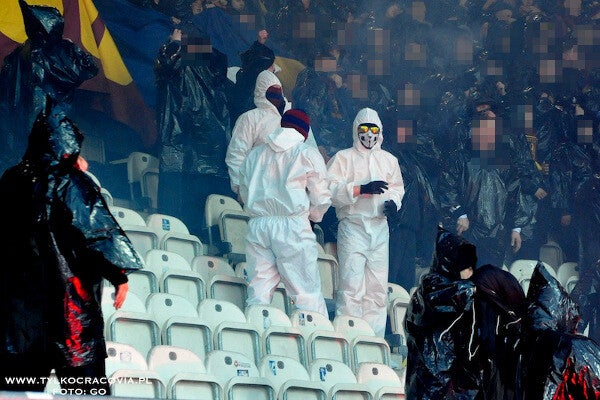
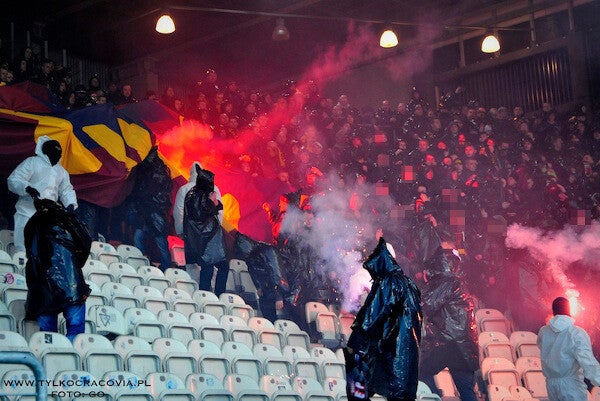
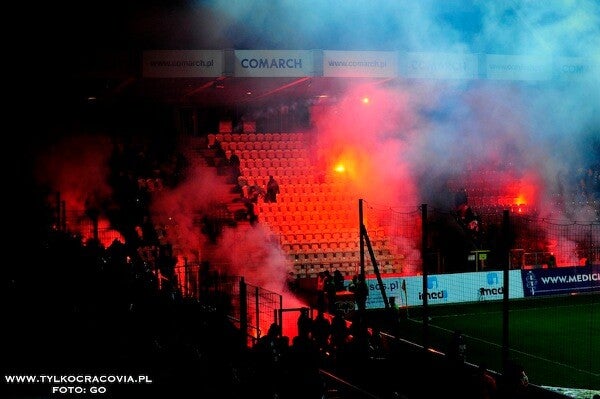
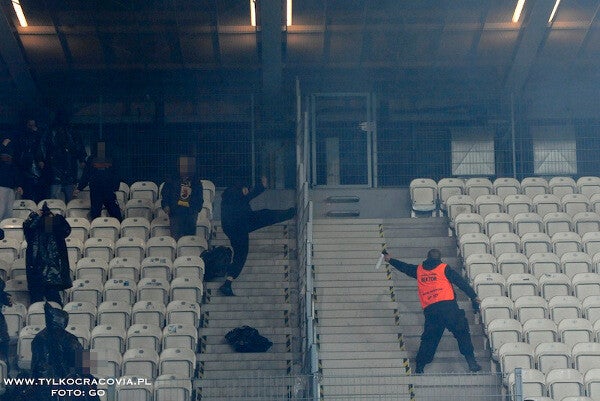
At the same time, I watched the behaviour of the people around the stadium. I saw strong emotions, shouting, vulgar behaviour, pyrotechnics and red light appearing in the stands. It was interesting for me because I was seeing from close range how strongly some people experienced football and supported their team.
For me, there was a difference between joking around with friends and actually becoming involved in the behaviour of people who were taking the rivalry very seriously.
Our teacher was also keeping an eye on us. When our jokes or words went too far, she reminded us to behave properly.
Looking back, this is another part of the experience that I find interesting. At that age, I approached many things with a lot of distance. We joked with each other and I observed the behaviour of the people around us.
Over time, I began to understand for myself that joking with friends is one thing, while the real behaviour of people under strong emotions during a football match can be something completely different.
It was simply another thing I was discovering and beginning to understand as a young person.
The match eventually ended with Pogoń Szczecin winning. Cracovia had opportunities to change the result, but in the end they were unable to win. After the match finished, we left the stadium and later returned to our school and boarding accommodation.
After all these years, however, the final score is not the most important thing I remember about that day.
I remember the preparation at school.
I remember around two weeks of practising the anthem.
I remember the entrance leading towards the pitch.
I remember the bright, open stadium appearing in front of me.
I remember my first step onto the grass.
I remember how enormous the pitch looked.
I remember my Cracovia scarf.
I remember the sounds of the stadium through my implant.
I remember performing the anthem together in sign language.
Most importantly, I remember being one of five young Deaf people who stood on the pitch at Cracovia Stadium that day and performed the club’s anthem in sign language.
There is also an interesting story connected with the surviving material from that event.
Our group consisted of five young Deaf people. Our teacher was there with us as well, making six of us altogether. In one of the surviving videos, our teacher and four of the five young people from our group can be seen.
Unfortunately, the camera did not capture me properly. I was standing on the left side wearing my distinctive yellow jacket, but the part of the frame where I was standing effectively appears empty.
It is a little disappointing because, after so many years, I would like to be able to see myself in that particular recording. Fortunately, the video is not the only material that remains from that day. There are also original photographs showing me at the event and documenting that experience.
For this reason, I want to keep both the photographs and the available video material together with this story. Even though one recording did not capture me properly, all of these materials together remain part of the history of that day.
For me, this was not simply another Cracovia football match.
First, we spent around two weeks preparing at school. Then we actually walked onto the pitch of a professional football stadium. We performed the anthem in sign language, left the pitch and later watched the match from the VIP area, experiencing the stadium from another perspective.
I was younger then and looked at many things differently from the way I do today. I did not analyse everything deeply. I joked, observed what was happening around me, enjoyed the experience and gradually began to understand different kinds of behaviour and where certain boundaries were.
Today, I can look back at that day from a completely different perspective.
I am grateful to Cracovia for giving our group the opportunity to take part in this event. I am also grateful to our school and our teacher for preparing us, practising with us and looking after us throughout the experience.
We prepared for around two weeks. The performance itself was short. The memory has stayed with me for years.
DEAF LIFE & SIGN LANGUAGE
Being Deaf is a part of who I am and has shaped the way I experience the world. Sign language is more than communication to me — it connects me with people, experiences and the Deaf community. Over the years, I have taken part in different events and moments that became part of my story. Here, I share those experiences, from my younger years to where I am today.
MY FIRST MEDIA INTERVIEW - 2012
In 2012, when I was still young, my class travelled to Warsaw as part of a school trip. Through our school, we were given a special opportunity connected with Rodzinka.pl and TVP2. The visit had been organised for us by people I did not personally know. At first, I thought it would simply be another part of our school trip. I had no idea that I would suddenly become personally involved in something completely new.
Once we were there, things began to happen unexpectedly. My teacher chose me to take part. As I remember it, one of the reasons was that she believed I had a good and clear speaking voice. I was surprised. I had not arrived in Warsaw expecting to speak in front of television cameras, and one of the thoughts going through my head was simply: “Why me?”
Everything had to be prepared there, on the spot. I was given material on paper and had only a short amount of time to learn it, repeat the sentences and practise what I needed to say. I took it seriously. I tried to concentrate, remember everything and prepare myself mentally before it was time to stand in front of the camera.
This was especially significant to me because I was a young Deaf person at the time. My experience of communication, learning and confidence was very different from the way I experience those things today. Having to absorb information quickly, practise it and then speak publicly in a completely unfamiliar situation was a serious challenge for me.
It was not only one moment. As I remember it, I had to go through this kind of preparation three separate times, because three different situations came one after another. The first involved personally giving a gift I had prepared to one of the women at the event. Later came a moment with Małgorzata, and then another with Tomasz. Each time, it happened quite suddenly: I was given material on paper, had a short amount of time to learn and practise what I needed to say, and then had to be ready to do it in front of the cameras.
Then came the moments in front of the TVP2 camera, lights and microphone. What had started as a school trip suddenly became a real media experience. I knew that what I was doing could later be shown publicly to viewers across Poland. For someone my age, experiencing something like this for the first time, it was difficult to fully understand in the moment how unusual the situation really was.
I was nervous and shy. Inside, I did not always feel ready. But I tried to control those feelings and turn them into something positive. I wanted to stay mentally strong, remember what I had practised and do the best I could. Instead of allowing the fear to stop me, I went ahead and did it.
At the time, part of me felt almost as if I had suddenly become known because I had appeared in a real television environment. But looking back, I would not describe myself as famous. That was never the real meaning of this experience. What mattered was that I had been given an unexpected opportunity and managed to face something completely new.
Afterwards, people around me appreciated what I had done. Teachers, the school director and others congratulated me. I remember feeling proud and happy, even though I was also embarrassed by all the attention. For me, it felt like an important step and one of my first experiences of achieving something that I had never expected myself to do.
I am grateful to the people who organised this opportunity for our school and class, even though I did not personally know everyone behind it. I am also grateful to my teacher for choosing me and helping me prepare when everything happened so suddenly. Without those people, this experience probably would never have become part of my life.
Accessibility is also part of how I remember this experience. As a Deaf person, older television material can be difficult to follow or find in an accessible form, especially when subtitles are missing. Unfortunately, I no longer know where the original video material from those moments is. I hope that one day I may be able to find it again.
What I still have are the original photographs from that experience. When I look at them today, I remember being young, suddenly being chosen, receiving the material on paper, having very little time to practise, asking myself “Why me?”, and then finding enough courage to go in front of the camera.
Today, I see that experience differently than I did as a teenager. At the time, it was unexpected, stressful, exciting and sometimes embarrassing. Years later, it has become a happy and important memory. I am glad that I accepted the opportunity and tried, because it showed me at a young age that sometimes an unexpected moment can become part of your story for the rest of your life.


CRACOVIA & SIGN LANGUAGE
On 18 April 2015, I had the opportunity to take part in a special event at Cracovia Stadium in Kraków. Together with four other young Deaf people from our Special Educational Centre for Deaf Students in Kraków, we formed a group of five who performed Cracovia’s anthem in sign language before the match against Pogoń Szczecin.
Our teacher was also there with us. She also worked with us at the boarding school, knew us well, looked after us and supervised our group during the event. Altogether, there were six of us.
We had prepared for this day beforehand at school. As I remember it, for around two weeks we learned and practised the anthem in sign language. We repeated the signs many times, remembered their order and prepared ourselves to perform it together at the stadium.
In some ways, it reminded me of my earlier television experience in Warsaw in 2012, although the task was completely different. In Warsaw, I was given material on paper and had only a short amount of time to learn what I was going to say in front of the camera. With Cracovia, there was no script to learn from a piece of paper. This time, our task was sign language. We had time to practise at school so that when the day came, we would be ready to perform the anthem together.
After around two weeks of preparation, the actual day finally arrived.
One of my strongest memories is walking towards the pitch. I remember going through the doors and suddenly seeing the bright, open space of the stadium in front of me. It felt completely different from simply looking at a football pitch from the stands.
When I stepped onto the grass and saw the entire pitch from that level, it made a huge impression on me.
The pitch looked much bigger than I had imagined.
When I was younger, I had played football, including in Krzeszowice. I already knew what it felt like to be on a normal football pitch, but stepping onto the grass of a professional stadium was completely different. For a brief moment, I could imagine what it might feel like for a professional footballer to walk out onto a large stadium.
Of course, I was not there as a player. I was there together with our group to perform Cracovia’s anthem in sign language.
I also remember wearing my Cracovia scarf.
Our purpose on the pitch was simple and clear. We walked onto the grass, performed the anthem in sign language and, when our part was finished, we left the pitch.
Before the first whistle, the five of us stood on the pitch and prepared to do what we had been practising for the previous two weeks.
Then the anthem began.
While the anthem was being played and people around the stadium were singing, the five of us performed it together in sign language.
I am Deaf, but at that time I used a cochlear implant, which allowed me to hear the sounds around me. At the stadium, I remember the voices and shouting of the crowd, the singing, and different beats and rhythms that, in my memory, felt something like “knock, knock”. All of those sounds mixed together with the atmosphere inside the stadium.
At the same time, we were performing the anthem visually through sign language. People around the stadium were singing and creating the atmosphere with their voices, while our group performed the signs we had practised beforehand.
It was an interesting combination for me. I was experiencing the sounds of the stadium through my implant while at the same time using my hands to perform the anthem together with the other four young Deaf people.
Our performance itself did not last very long. When the anthem finished, our part on the pitch was finished too. We had done what we had prepared for, and we left the pitch.
Afterwards, another new experience was waiting for us. We were invited to watch the match from the VIP area.
I was curious about the place. I looked around at the surroundings and noticed people dressed more formally, including people wearing suits. At that age, I did not really know what a VIP area at a football stadium was like, so I simply observed everything around me and experienced something new.
A short time earlier I had been standing on the pitch. Now I was watching the stadium from a completely different perspective.
Then the match began.
Together with my friends, we joked, talked and enjoyed the rivalry between Cracovia and Pogoń Szczecin. There was plenty of humour and sarcasm between us about what was happening on the other side. We were young, enjoying ourselves and experiencing the atmosphere of the match.
At the same time, I watched the behaviour of the people around the stadium. I saw strong emotions, shouting, vulgar behaviour, pyrotechnics and red light appearing in the stands. It was interesting for me because I was seeing from close range how strongly some people experienced football and supported their team.
For me, there was a difference between joking around with friends and actually becoming involved in the behaviour of people who were taking the rivalry very seriously.
Our teacher was also keeping an eye on us. When our jokes or words went too far, she reminded us to behave properly.
Looking back, this is another part of the experience that I find interesting. At that age, I approached many things with a lot of distance. We joked with each other and I observed the behaviour of the people around us.
Over time, I began to understand for myself that joking with friends is one thing, while the real behaviour of people under strong emotions during a football match can be something completely different.
It was simply another thing I was discovering and beginning to understand as a young person.
The match eventually ended with Pogoń Szczecin winning. Cracovia had opportunities to change the result, but in the end they were unable to win. After the match finished, we left the stadium and later returned to our school and boarding accommodation.
After all these years, however, the final score is not the most important thing I remember about that day.
I remember the preparation at school.
I remember around two weeks of practising the anthem.
I remember the entrance leading towards the pitch.
I remember the bright, open stadium appearing in front of me.
I remember my first step onto the grass.
I remember how enormous the pitch looked.
I remember my Cracovia scarf.
I remember the sounds of the stadium through my implant.
I remember performing the anthem together in sign language.
Most importantly, I remember being one of five young Deaf people who stood on the pitch at Cracovia Stadium that day and performed the club’s anthem in sign language.
There is also an interesting story connected with the surviving material from that event.
Our group consisted of five young Deaf people. Our teacher was there with us as well, making six of us altogether. In one of the surviving videos, our teacher and four of the five young people from our group can be seen.
Unfortunately, the camera did not capture me properly. I was standing on the left side wearing my distinctive yellow jacket, but the part of the frame where I was standing effectively appears empty.
It is a little disappointing because, after so many years, I would like to be able to see myself in that particular recording. Fortunately, the video is not the only material that remains from that day. There are also original photographs showing me at the event and documenting that experience.
For this reason, I want to keep both the photographs and the available video material together with this story. Even though one recording did not capture me properly, all of these materials together remain part of the history of that day.
For me, this was not simply another Cracovia football match.
First, we spent around two weeks preparing at school. Then we actually walked onto the pitch of a professional football stadium. We performed the anthem in sign language, left the pitch and later watched the match from the VIP area, experiencing the stadium from another perspective.
I was younger then and looked at many things differently from the way I do today. I did not analyse everything deeply. I joked, observed what was happening around me, enjoyed the experience and gradually began to understand different kinds of behaviour and where certain boundaries were.
Today, I can look back at that day from a completely different perspective.
I am grateful to Cracovia for giving our group the opportunity to take part in this event. I am also grateful to our school and our teacher for preparing us, practising with us and looking after us throughout the experience.
We prepared for around two weeks. The performance itself was short. The memory has stayed with me for years.


